11 Nov 2026
How Technology is Revolutionizing Cotton Yarn Manufacturing
26 Nov 2026
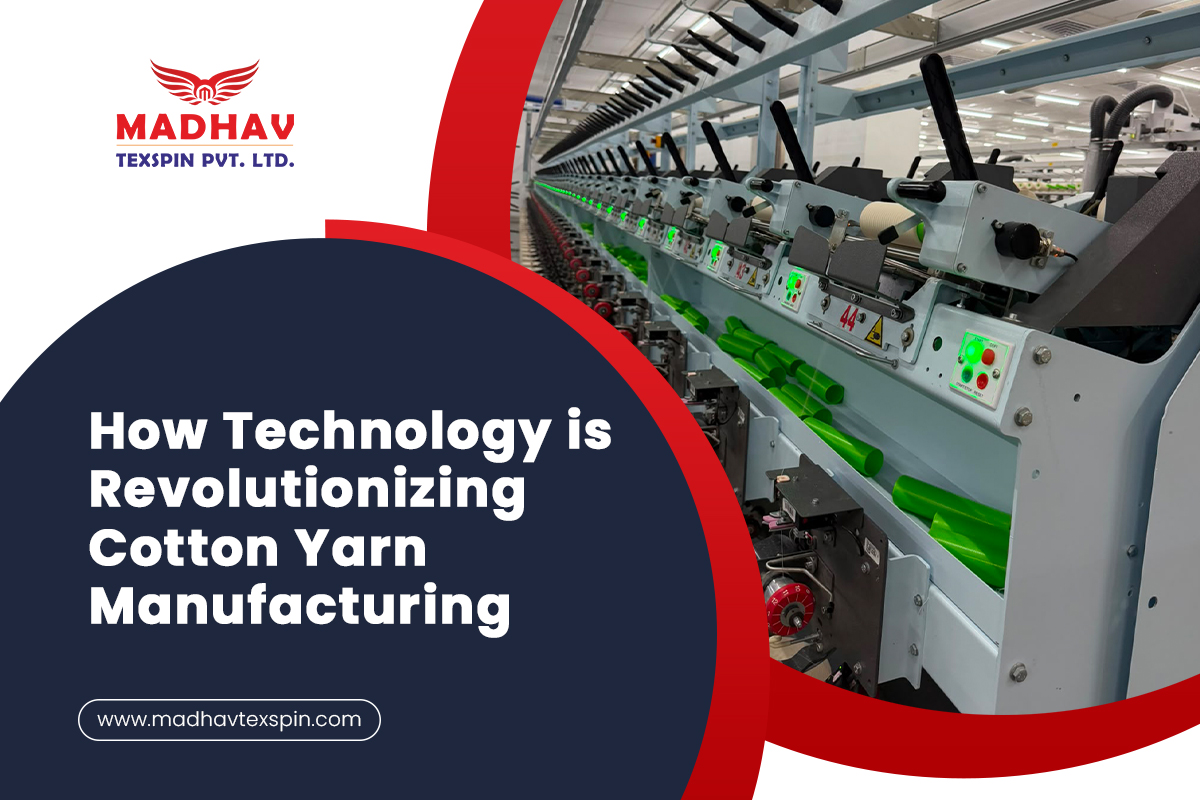
From automated blow-rooms to compact spinning, real-time monitoring, and predictive maintenance, technology is changing how cotton yarn is made. Here is what it means for quality, cost, and reliability.
Many people picture cotton spinning as it was decades ago: noisy sheds, heavy manual handling, and quality judged largely by an experienced eye and a hand. That picture is out of date. Today’s best spinning mills are connected, measured, and increasingly self-correcting. Technology now affects almost every step between a compressed cotton bale and a finished cone of yarn.
At Madhav Texspin, we see this change in our daily operations. This blog explains where technology is making the biggest difference, why it matters for buyers, and what we expect next.
From Bale to Cone: A Process Built on Precision
Yarn quality starts long before the ring frame. It begins with how cotton bales are managed, opened, cleaned, and blended. Automated blow-room and carding lines have taken much of the guesswork out of this stage. Consistent opening and cleaning, along with even blending of fibre from different bales, give every later process a stable starting point. If the input varies, the yarn will vary too, and no downstream machine can fully fix that.
Our own process runs from cotton bale management to final yarn winding. It is supported by machinery from globally reputed manufacturers including Trützschler, Rieter, LMW, Savio, Uster, and Premier. Because each stage is automated and closely matched to the next, the mill behaves as one coordinated system instead of a series of separate machines.
Compact Spinning and Better Yarn Structure
Spinning technology itself has also advanced. In conventional ring spinning, a small triangle of loose fibres forms between the drafting zone and the twist point. Some of those fibres stick out as hairiness or are lost as waste. Compact spinning addresses this by condensing the fibre strand before twisting, usually with suction.
The result is a different yarn structure. Research comparing the two methods reports that compact yarns have higher strength and elongation at break than conventional ring-spun yarns. Another technical paper describes the compact yarn structure as giving better strength, better elongation, and reduced hairiness. For weavers and knitters, less hairiness often means smoother running on the loom, fewer stoppages, and cleaner fabric.
Ring-spun yarn still has its place. For many standard applications it performs well at a lower cost. The real change is that spinners can now match the process to the end use more precisely instead of offering one solution for every need.
Auto Winders and Clearing Technology
Winding is where yarn quality gets its final check. Modern auto winders transfer yarn from ring-frame bobbins to larger cones while splicing joins and tensioning the yarn evenly. Electronic yarn cleaners scan the yarn as it passes and cut out defects such as thick places, thin places, and foreign matter. The cut is repaired with a clean splice.
What used to depend on visual inspection is now done continuously and objectively. Defects that might have reached a customer’s loom are caught at the mill. For a fabric manufacturer, this means fewer faults in grey cloth, fewer rejections, and less rework.
Testing and Measuring Quality in Detail
Technology has also changed how quality is judged. Instruments such as the Uster Tester measure yarn evenness, imperfections, and hairiness with great precision, and the company describes its Tester 6 as the standard for yarn testing in spinning mills. Evenness is usually expressed as U% and CV%, and a lower CV% means more consistent yarn and fewer fabric problems.
The next step is connecting lab results with production data. Linking test results to the machine, shift, material, and production record lets quality teams turn lab findings into process decisions. If a quality drift appears, the mill can trace it to its source and fix the cause instead of treating the symptom.
Real-Time Monitoring and the Digital Mill
The most visible change in recent years is real-time monitoring. Digital systems now record production, efficiency, energy consumption, and quality as they happen. Rieter describes its ESSENTIAL system as one that records and connects all of this data in real time. Its monitoring module is designed to show weak points in the process as they emerge.
At Madhav Texspin, real-time spindle and process monitoring is part of how we run the plant. Seeing a problem as it develops, not at the end of a shift or after a complete lot, means we can intervene early. That protects yarn quality, reduces waste, and keeps delivery schedules dependable.
Predictive Maintenance: Fixing Problems Before They Happen
Traditionally, mills maintained machines either on a fixed calendar or after something broke. Both approaches have costs. Calendar-based maintenance can replace parts that are still fine, while breakdown maintenance interrupts production at the worst moment.
Predictive maintenance works differently. Sensors and software track the condition of machines, such as vibration patterns at the spindle, and flag unusual behaviour before a failure. Industry sources describe how textile mills use AI-based predictive maintenance on spinning frames and other equipment to reduce yarn breakage and fabric defects. Figures quoted for these systems vary by vendor and mill, so any claimed saving should be treated as indicative, not guaranteed.
Preventive maintenance systems are already an established part of our operations, and they give a solid foundation for moving toward more data-driven methods. The principle is the same either way: a machine that is well looked after produces steadier yarn.
Technology and Sustainability Work Together
Technology is not only about speed and quality. It is one of the most practical tools for reducing a mill’s environmental footprint. Digital systems that track energy consumption by machine and by section help engineers find where power is being wasted. Rieter notes that its machines, systems, and services are designed to save energy and optimise resource use.
Less waste, fewer breakages, and more efficient machines all mean less fibre and less energy for every kilogram of yarn. In this sense, a better-run mill is almost always a greener mill, and buyers who care about both cost and environmental impact benefit from the same improvements.
The Human Side of a Technology-Driven Mill
Automation does not remove the need for skilled people. It changes what they do. Technicians and supervisors spend less time on repetitive manual work and more time interpreting data, adjusting settings, and solving problems. Experience in textiles, combined with comfort around digital tools, is becoming the most valuable skill set on the spinning floor. Mills that invest in training their teams will get far more from their machinery than those that simply buy new equipment.
What Is Coming Next
Several developments are likely to shape the next stage of yarn manufacturing. Machine learning models will get better at predicting yarn breakage and quality variation from process data. Systems will increasingly adjust settings automatically within safe limits. Full batch-level traceability, from cotton lot to delivered cone, will become a standard expectation. Energy management will become more granular, with live tracking of power use per kilogram of yarn.
None of these changes will happen overnight, and not every mill will adopt them at the same pace. The mills that build strong foundations now, with good machinery, disciplined processes, and reliable data, will be best placed to take advantage of them.
What This Means for Buyers
If you buy cotton yarn, technology should translate into benefits you can feel: consistent count and strength across lots, fewer defects reaching your looms or knitting machines, dependable delivery, and a supplier who can explain and document how quality is controlled. When you assess a spinning partner, ask about their machinery, their testing and monitoring practices, and how they maintain their equipment. The answers reveal how ready the mill is to deliver steady quality over the long term.
Our Commitment
At Madhav Texspin, we combine globally reputed machinery, automated blow-room and carding lines, precision ring frames and auto winders, real-time spindle and process monitoring, and preventive maintenance systems. Together they support high operational efficiency, minimal downtime, and consistent yarn quality.
If you want a yarn supplier that treats technology as a tool for reliability, we would be glad to hear from you. Visit Madhav Texspin to learn more or send an inquiry.
Recent Posts