12 Oct 2026
Why TFO Doubled Yarn Is Used for High-Quality Denim and Jeans Fabric
24 Sep 2026
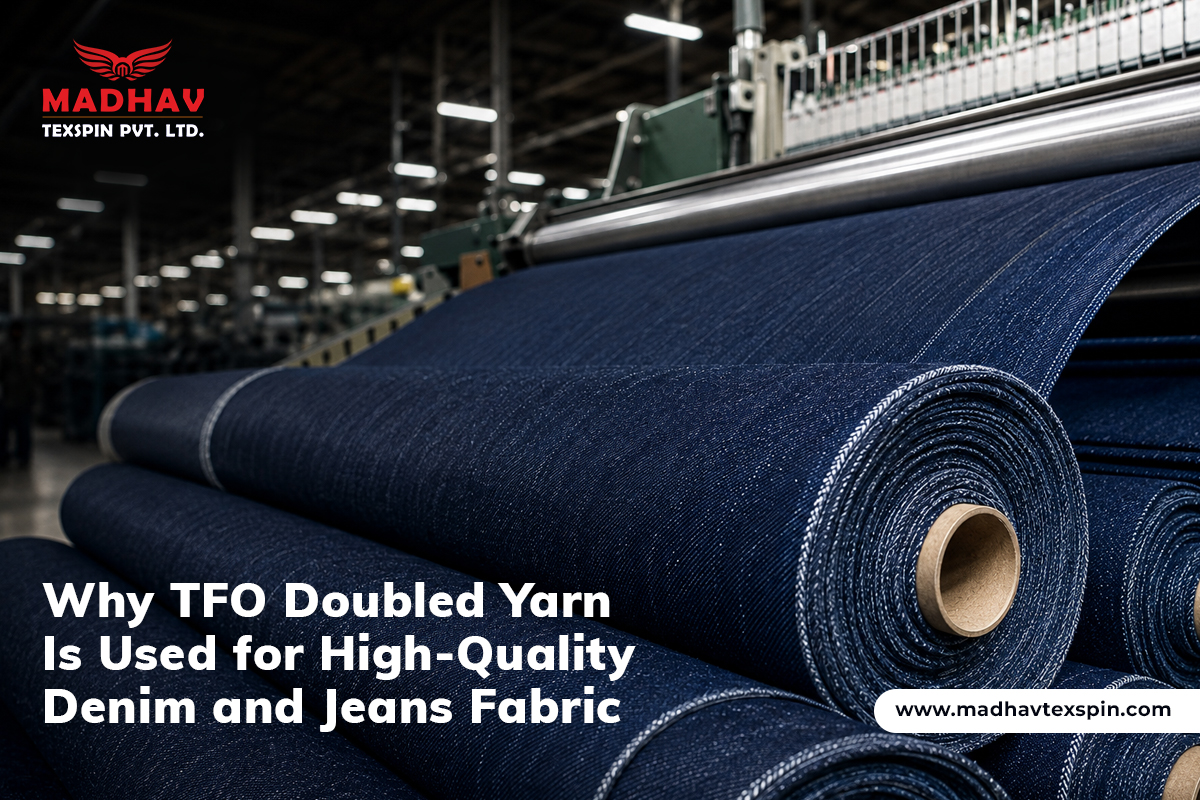
Denim is not just a fabric, it is a global symbol of durability, style, and everyday resilience. From the rugged workwear of the 19th century to the fashion runways of Milan, denim has earned its reputation by being tough enough to endure and refined enough to look good doing it. But behind every pair of premium jeans lies a critical decision that determines whether the fabric will hold up or fall apart: the choice of yarn.
This is exactly where TFO doubled yarn enters the picture and why it has become the preferred choice for manufacturers producing high-quality denim and jeans fabric worldwide.
Understanding TFO Doubled Yarn
TFO stands for “Two-For-One” twisting. It is a yarn doubling technology where two single yarns are combined and twisted together, with the spindle inserting two twists for every single rotation. This is fundamentally different from traditional ring doubling, where one rotation produces only one twist. The result is a yarn that is stronger, more uniform, and produced at significantly higher speeds.
In TFO doubling, two or more single-ply yarns are first wound together onto a parallel package (called a cheese) through an assembly winding process. This cheese is then fed into the TFO twister, where the yarns are twisted together in the opposite direction to their original single-yarn twist, typically an “S” twist over a “Z” twist. This opposing twist structure is what gives the final doubled yarn its balance, stability, and resistance to untwisting or snarling.
What Makes Denim So Demanding?
Denim is woven in a twill weave, typically a 2/1 or 3/1 construction where the indigo-dyed warp yarn passes over two or three weft yarns before going under one. This weave structure places enormous stress on the warp yarns during the weaving process. The warp threads are subjected to constant tension, abrasion from the loom’s heddles and reed, and repeated bending as the shed opens and closes thousands of times per metre of fabric produced.
A typical denim warp yarn ranges from 6 Ne to 20 Ne, relatively coarse counts that must endure punishing mechanical forces. If the warp yarn breaks frequently during weaving, production efficiency drops, fabric defects increase, and the final product suffers in both appearance and durability. This is precisely why yarn strength, evenness, and abrasion resistance matter so much in denim manufacturing and why TFO doubled yarn delivers a clear advantage.
The Specific Advantages of TFO Doubled Yarn in Denim
Superior Strength and Elongation. Research conducted by SITRA (The South India Textile Research Association) across 100 Indian spinning mills found that TFO doubling increases single yarn strength by approximately 110% in cotton yarns. Elongation at break, a critical property for weavability also improves by about 8–10%. For denim, this translates directly into fewer warp breaks on the loom, smoother weaving runs, and a fabric that can withstand the heavy-duty use that consumers expect from jeans.
Dramatically Reduced Imperfections. The same SITRA study documented a 90–95% reduction in total yarn imperfections (thick places, thin places, and neps) in TFO doubled cotton yarns compared to their single-yarn counterparts. Imperfections averaged just 20–30 per kilometre in doubled yarns versus several hundred in singles. For denim, fewer imperfections mean a cleaner fabric surface, more consistent indigo dye uptake, and a premium visual finish that distinguishes high-quality jeans from mass-market alternatives.
Improved Evenness. TFO doubling improves yarn evenness (U%) by approximately 25% over single yarns. Because the doubling process combines two yarns, the thick spots in one yarn tend to be compensated by thinner spots in the other, a natural statistical averaging effect. The resulting uniformity is visible in the finished denim as consistent weight, even texture, and a smooth hand feel.
Uniform Twist Distribution. Unlike ring doublers, where twist insertion can vary along the yarn length, TFO twisters deliver remarkably consistent twist levels. This uniformity is essential for denim warp yarns because inconsistent twist creates weak points that are prone to breakage under loom tension. The TFO process ensures that every metre of yarn has the same structural integrity.
Better Fabric Stability and Reduced Shrinkage. The balanced twist structure of TFO doubled yarn where the ply twist opposes the single-yarn twist at an optimal D/S (doubled-to-single twist) ratio of approximately 0.7 for cotton, produces a yarn that lies flat, resists torque, and doesn’t bias the fabric. For jeans, this means less leg twist, more predictable shrinkage behaviour after washing, and a garment that maintains its shape through years of wear.
Enhanced Abrasion Resistance. Denim jeans are subjected to intense friction at the knees, thighs, seat, and pocket edges. The tightly bound structure of TFO doubled yarn provides superior resistance to surface abrasion compared to single-ply yarns, extending the garment’s lifespan and developing the desirable “fade” character that denim enthusiasts prize.
Where TFO Doubled Yarn Fits in Denim Construction
While the indigo-dyed warp is the most visible element of denim, TFO doubled yarn plays a role across the fabric’s architecture. In heavyweight selvedge denim the kind prized by raw denim connoisseurs, doubled yarn is used in both warp and weft to achieve the thick, substantial hand feel and exceptional durability that define the category. In lighter-weight stretch denim, doubled yarn in the warp provides the structural backbone that prevents the fabric from losing its shape even with the addition of elastane in the weft.
TFO doubled yarn is also increasingly used in denim’s finishing and reinforcement threads the stitching yarns that hold pockets, belt loops, and seams together, where strength under repeated stress is non-negotiable.
Recent Posts