12 Oct 2026
What Determines Cotton Yarn Strength and Durability?
19 Aug 2026
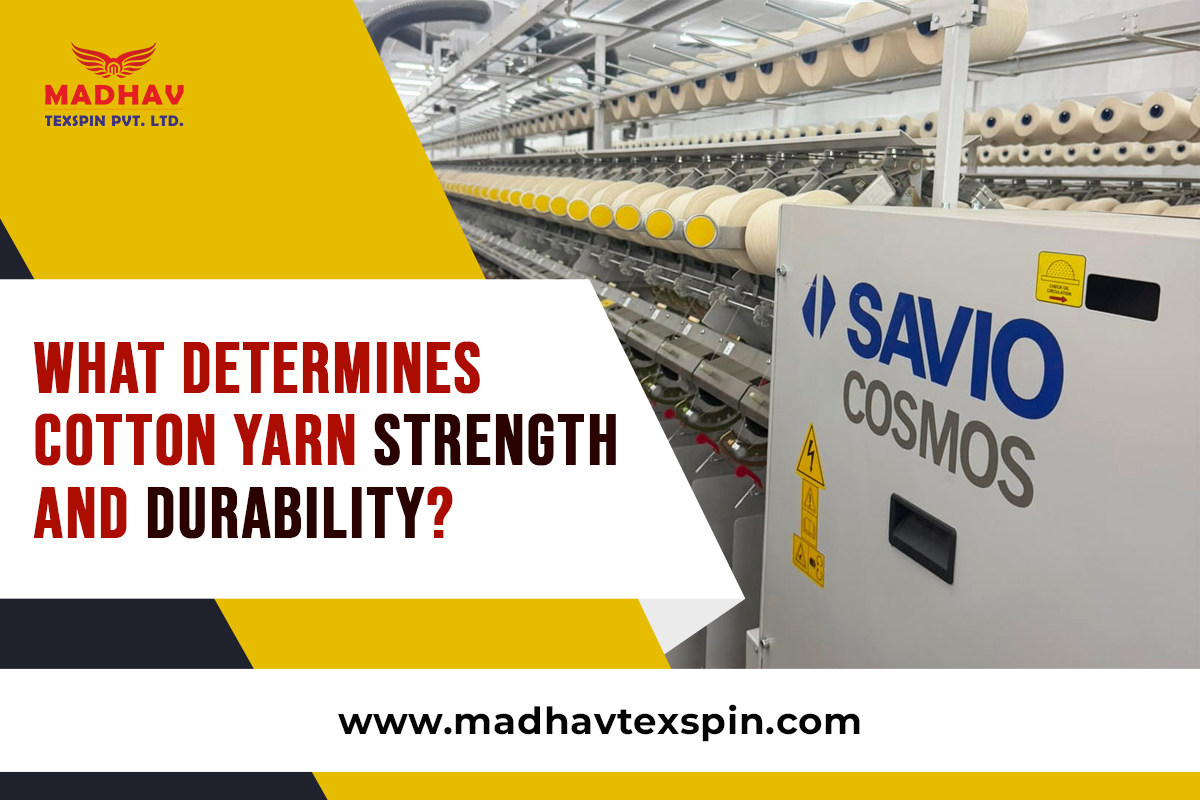
When a garment tears at the seam after a few washes, or a fabric pills and thins out within weeks, the culprit often traces back to a single point of origin; the yarn. Yarn strength and durability are not accidental qualities. They are the result of precise decisions made long before the yarn reaches a loom or knitting machine, beginning with the cotton field and extending through every stage of the spinning process.
At Madhav Texspin, a leading cotton yarn manufacturer based in Rajkot, Gujarat, we understand these variables intimately. With over 26,112 spindles, world class machinery from Trützschler, Rieter, LMW, and Savio, and an annual production capacity of 8,400 tons, our entire operation is built around the science of producing strong, consistent, and durable cotton yarn. In this blog, we break down the key factors that determine cotton yarn strength and durability knowledge that every textile manufacturer, garment exporter, and fabric buyer should understand.
It All Starts with Fibre Length
If there is one single property that has the greatest influence on yarn strength, it is staple length the average length of the cotton fibre. Longer staple fibres create more contact points between individual fibres when they are twisted together during spinning. This greater inter fibre friction translates directly into higher tensile strength. Long staple cotton (typically 28–34 mm) and extra long staple cotton (above 34 mm) produce yarns that are noticeably stronger, smoother, and more resistant to breakage than those spun from short staple varieties.
At Madhav Texspin, raw cotton selection is the very first step in our integrated manufacturing process. Our team evaluates every bale for staple length, uniformity, and fibre distribution before it enters the blow room line, because we know that no amount of downstream processing can compensate for poor fibre selection.
Fibre Strength, The Foundation You Cannot See
Closely related to staple length is the inherent tensile strength of the cotton fibre itself. This is measured in grams per tex (g/tex) using instruments like the HVI (High Volume Instrument) system. Fibres with higher tenacity hold up better under the mechanical stresses of spinning, weaving, and garment use. A cotton bale with fibre strength above 29 g/tex is generally considered strong, while readings above 31 g/tex place it in the premium category.
Strong fibres allow manufacturers to achieve the desired yarn strength with relatively lower twist, which in turn preserves softness and flexibility, a balance that is critical for comfortable garments.
Length Uniformity and Short Fibre Content
It is not enough for cotton to have long fibres; those fibres must also be uniform in length. A length uniformity ratio above 80% indicates that the majority of fibres in a sample are close to the mean staple length. When uniformity drops, it signals a higher proportion of short fibres, those under 12.7 mm, which create weak points in the yarn structure.
Short fibres do not grip well during spinning. They produce more fly waste, increase yarn hairiness, and create thin spots that are prone to breakage under tension. Maintaining strict control over short fibre content during ginning, blow room processing, and carding is essential for producing yarn with reliable durability. Our automated blow room and carding lines at Madhav Texspin are calibrated specifically to minimise fibre damage and remove short fibre without compromising the longer, stronger fibres.
Micronaire; The Fineness and Maturity Factor
Micronaire is a measurement that captures both fibre fineness and fibre maturity in a single reading. It is one of the most important yet often misunderstood parameters in cotton yarn manufacturing. The ideal micronaire range for most yarn applications falls between 3.8 and 4.5.
Fibres with very low micronaire (below 3.5) tend to be immature, meaning their cell walls have not fully developed. Immature fibres are weaker, absorb dye unevenly, and produce neps tiny knots that appear as defects in the finished fabric. On the other hand, excessively high micronaire (above 5.0) indicates coarse fibres that produce stiffer, less uniform yarn. Getting this balance right during cotton selection has a profound impact on both the strength and the visual quality of the final yarn.
The Critical Role of Twist
Once the fibre enters the spinning frame, twist becomes the most controllable factor affecting yarn strength. Twist binds individual fibres together, and the degree of twist measured in Turns Per Inch (TPI) or Turns Per Metre (TPM)determines how tightly those fibres grip one another.
The relationship between twist and strength follows a parabolic curve. As twist increases from zero, yarn strength rises steadily because fibres are packed closer and friction between them increases. Strength reaches a peak at the optimal twist point, beyond which further twisting actually weakens the yarn. Over twisting creates excessive internal stress, damages fibre surfaces, and leads to problems like snarling, reduced elasticity, and poor moisture wicking properties.
Striking this balance requires precision engineering. At Madhav Texspin, our precision ring frames and real time spindle monitoring systems allow us to maintain consistent twist parameters across thousands of spindles simultaneously, ensuring every cone of yarn delivers the same strength characteristics.
Spinning Technology Matters
The method of spinning itself significantly influences yarn strength. Ring spinning, which is the primary technology employed at Madhav Texspin, produces yarn with superior fibre integration, higher tenacity, and a smoother surface compared to open end rotor spinning. Studies show that compact ring spun yarn can achieve tensile strengths of 18.52 cN/tex for a 30 Ne count, compared to around 12.85 cN/tex for rotor spun equivalents.
Compact spinning takes this further by condensing the fibre strand just before twist insertion, reducing hairiness and improving fibre utilisation. This is why our combed compact yarn range available from Ne 16s to Ne 120s is preferred by manufacturers who demand both strength and surface quality in their fabrics.
Evenness and Consistency Across the Yarn Body
A yarn may have excellent average strength, but if it contains thick and thin places, neps, or count variations, it will still fail in production. These irregularities create localised weak spots where breakage is most likely to occur. Yarn evenness, measured as CVm% (coefficient of variation of mass), is a critical quality metric that directly correlates with both spinning performance and fabric durability.
Our in house testing laboratories at Madhav Texspin, equipped with Uster and Premier instruments, continuously monitor parameters like CVm%, imperfections per kilometre, and hairiness index. Deviations are flagged and corrected in real time, so that the yarn reaching our customers is consistent not just within a single cone, but across entire production lots.
Environmental and Processing Conditions
Factors that are often overlooked include humidity, temperature, and processing speeds within the spinning mill. Cotton fibre behaves differently under varying moisture conditions too dry, and it becomes brittle and prone to breakage; too humid, and it becomes sticky, causing roller lapping and uneven drafting. Maintaining a controlled environment across the blow room, carding, drawing, and spinning departments is essential for preserving fibre strength throughout the process chain.
At Madhav Texspin, our preventive maintenance and calibration programs ensure that machinery operates within optimal parameters, and environmental controls maintain consistent conditions across every department.
Why It Matters to Your End Product
Understanding what determines yarn strength and durability is not just an academic exercise. For garment manufacturers, it directly impacts fabric tear strength, seam integrity, pilling resistance, and the lifespan of the finished garment. For fabric mills, it affects loom efficiency, end breakage rates, and production costs. For brands, it defines product quality, customer satisfaction, and return rates.
Every decision from raw cotton selection to twist calibration to quality testing contributes to whether a yarn performs reliably or falls short.
Partner with the Right Yarn Manufacturer
At Madhav Texspin, yarn strength and durability are not left to chance. They are engineered through disciplined raw material selection, advanced spinning technology, rigorous in house testing, and a manufacturing philosophy rooted in consistency and precision. Whether you need Open End yarn, Ring Spun carded or combed compact yarn, Eli Twist, TFO doubled yarn, or sustainable and organic options, every product we deliver is built to perform.
Recent Posts